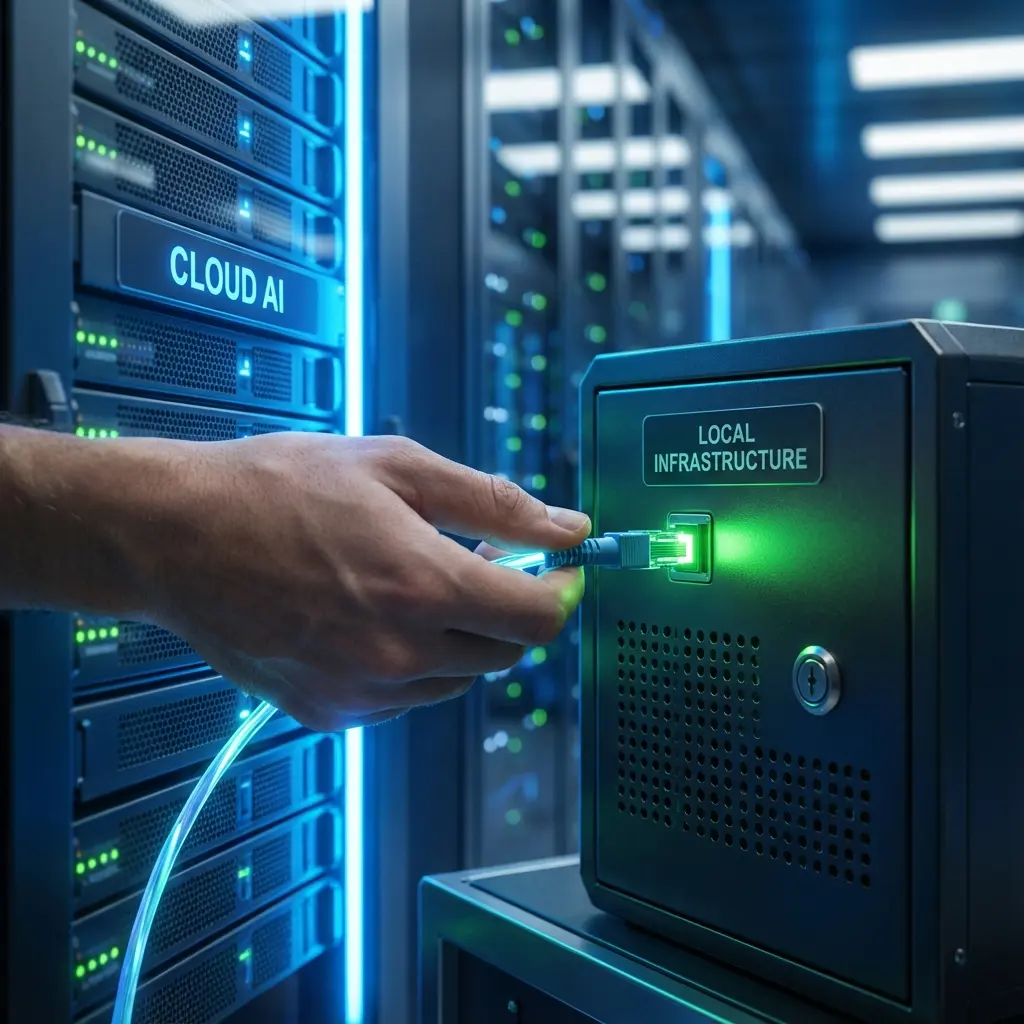
While headlines celebrated AI adoption rates hitting 78% across enterprises, a quieter story emerged in the infrastructure layer. Ollama grew 180% year over year, establishing itself as the de facto standard for running large language models on hardware you actually own.
This wasn't a trend. This was a migration.
We're watching organizations realize what we've been documenting for years: the cloud AI model creates tenants, not owners. And tenants don't build sellable assets.
The Adoption-Failure Paradox Nobody Talks About
Here's the number that should make you pause: 95% of GenAI pilots fail.
Not struggle. Not underperform. Fail.
MIT research confirms only 5% of generative AI programs achieve rapid revenue acceleration. Yet adoption continues to surge—from 55% to 78% in just twelve months for enterprise AI, with generative AI specifically hitting 71% penetration.
This creates a fascinating paradox. Organizations are rushing into AI infrastructure faster than ever while simultaneously experiencing catastrophic implementation failure rates.
The gap isn't technical capability. It's structural understanding.
Most enterprises treat AI deployment like software adoption—sign the SaaS agreement, integrate the API, measure efficiency gains. But AI infrastructure doesn't behave like traditional software. It learns from your data. It encodes your operational intelligence. It becomes a repository of your proprietary decision-making patterns.
And if you're renting that infrastructure, you're not accumulating an asset. You're feeding someone else's.
The Data Sovereignty Reckoning
Meta learned this lesson expensively: $1.3 billion in fines for transferring personal data from the EU to the US without adequate privacy protections.
That fine represents more than regulatory punishment. It signals a fundamental shift in how governments and enterprises view data movement across borders and systems.
The technical reality most organizations don't grasp: AI models continue fine-tuning as they receive inputs. Your queries don't just generate responses—they potentially influence future outputs. In some architectures, your proprietary information could resurface as someone else's suggestion.
This invisible exposure led some organizations to ban employee use of generative AI entirely. But prohibition doesn't solve the underlying problem. It just drives usage underground.
The IDC study reveals the scope: 75% of knowledge workers use generative AI at work. Some through approved enterprise tools. Many through publicly available services.
This is shadow AI. And it represents systematic data leakage happening right now, in organizations that believe they've secured their information perimeter.
For government, defense, healthcare, and financial sectors, this isn't a compliance inconvenience. It's an existential infrastructure problem. Data sovereignty isn't negotiable in these domains—it's the foundational requirement that determines whether AI deployment is even possible.
The Economics of Ownership vs. Rental
Let's address the assumption that keeps organizations locked into cloud dependency: the belief that local infrastructure sacrifices performance or explodes costs.
The numbers tell a different story.
Organizations implementing hybrid AI architectures—combining local processing with selective cloud usage—report 15-30% cost savings compared to pure-cloud approaches. More significantly, for any organization spending more than $500 monthly on cloud API services, local LLM deployment typically reaches break-even within 6-12 months.
Consider the extreme case: training a model like Llama 3.1 on AWS P5 instance H100 systems would cost over $483 million in cloud expenses, ignoring storage requirements entirely.
The cost structure fundamentally differs.
Cloud AI charges per token, per request, per interaction. Your costs scale linearly with usage. Local LLMs require initial hardware investment and ongoing electricity costs—predictable, fixed expenses that don't multiply as your operations expand.
This creates a different relationship with the technology. Cloud AI remains an operational expense that appears on your P&L every month. Local AI infrastructure becomes a capital asset that appears on your balance sheet—something you own, something that increases business valuation, something transferable when you sell.
We've watched this realization change how executives approach AI budgeting. The conversation shifts from "How much will this cost per month?" to "What asset are we building?"
Performance Parity Changes Everything
The final barrier keeping organizations cloud-dependent was performance.
That barrier collapsed in 2024.
Cloudera documented a case study that demolishes the local-performance myth: they deployed a distilled Llama 3.1 8B model that outperformed a prior Goliath 120B model by 70% in accuracy while unlocking 11x greater throughput. Processing time dropped 95%.
Read that again. A smaller local model outperformed a massive cloud model while processing faster and costing less to operate.
This isn't theoretical. This is production infrastructure delivering measurable business outcomes.
The quality gap between open-source local models and proprietary cloud services continues narrowing. In many business applications—document analysis, internal knowledge retrieval, process automation—local models now match or exceed cloud alternatives.
The performance argument for cloud dependency no longer holds.
What Ollama Actually Represents
Ollama isn't just another tool for running language models locally. It represents the infrastructure layer for a fundamental architectural shift.
The 180% year-over-year growth signals something larger than adoption metrics. It indicates organizations actively migrating away from cloud dependency toward owned infrastructure.
This is the local-first movement materializing in enterprise architecture.
The technical implementation matters less than the strategic implication: organizations can now deploy production-grade AI that processes sensitive data entirely within their infrastructure boundaries. No external API calls. No data leaving the network perimeter. No ongoing subscription fees.
For GDPR-sensitive workflows and regulated industries, this changes the feasibility calculation entirely. AI deployment becomes possible where it was previously prohibited.
The Control Problem Cloud Providers Won't Mention
Choosing a public cloud provider creates an inherent control trade-off most procurement processes ignore.
You don't know exactly where your data is stored. You can't audit the security measures protecting it. You depend on the provider's policy decisions about model updates, pricing changes, and service continuations.
Companies can't rely on cloud providers to enforce data sovereignty requirements on their behalf. The responsibility remains with the organization, but the control mechanisms live with the vendor.
This creates a structural vulnerability. Your AI infrastructure depends on external policy decisions you can't influence. Service discontinuations, pricing changes, and model updates happen according to vendor timelines, not your operational requirements.
Organizations insulated from these risks share a common pattern: they own their infrastructure. Model updates happen on their schedule. Pricing remains predictable. Service continuity depends on their decisions, not vendor strategy shifts.
This insulation has a name. It's called ownership.
The Asset Question Nobody Asks
Here's the question that should reshape how you think about AI investment:
If you sold your business tomorrow, what happens to your AI capabilities?
With cloud AI, the answer is simple: the buyer inherits your subscription agreements and API integrations. They don't acquire intelligence infrastructure—they acquire ongoing expenses and vendor dependencies.
With owned local AI infrastructure, the answer changes completely. The buyer acquires the models you've fine-tuned on your operational data. They inherit the automation systems you've built. They gain the intelligence infrastructure you've developed.
This is a sellable asset, not a recurring cost.
The business valuation implications are substantial. Proprietary AI infrastructure that encodes your operational intelligence and runs independently of external dependencies represents tangible business value. It's property, not rental.
We've built our entire approach around this distinction. The AI infrastructure we deliver doesn't create ongoing dependency on our access or external services. It functions as a business component the organization truly owns—something that increases valuation and transfers with the business.
What This Migration Actually Requires
Moving from cloud dependency to owned infrastructure isn't a simple tool swap. It requires a different mental model.
Organizations succeeding in this transition share specific patterns:
They start with diagnostic audits rather than solution shopping. They map current infrastructure, identify integration points, and understand where ownership gaps create vulnerability before prescribing technical interventions.
They optimize existing infrastructure first. Most organizations already own hardware capable of running local models. The constraint isn't capability—it's awareness and configuration.
They measure value in asset accumulation, not just efficiency gains. Time savings matter, but the primary metric becomes: are we building something we own, or renting someone else's infrastructure?
They accept the diagnostic and design phase. Quick-fix approaches fail because they address symptoms rather than infrastructure. Sustainable local AI deployment requires understanding the organization's specific operational patterns and data flows.
They think in ownership timelines, not subscription cycles. The ROI calculation extends beyond monthly cost comparison to include asset valuation, data sovereignty value, and independence from vendor policy changes.
The Awareness Gap That Creates Opportunity
Most organizations don't realize local AI infrastructure is viable because the information asymmetry favors cloud providers.
Cloud vendors optimize marketing spend and sales infrastructure around subscription models. Open-source local alternatives depend on technical communities and word-of-mouth adoption. The visibility gap creates a perception gap.
This awareness deficit is systematic, not accidental.
Convenience bias reinforces cloud dependency. Procurement processes optimize for immediate cost reduction rather than long-term asset creation. Marketing volume drowns education about structural alternatives.
But the organizations that bridge this awareness gap gain structural advantages their competitors lack. They control their data. They own their intelligence infrastructure. They build sellable assets while others accumulate subscription expenses.
The 180% growth in Ollama adoption suggests this awareness gap is closing. Organizations are discovering that local AI infrastructure isn't just viable—it's often superior for their specific requirements.
What We're Actually Watching Happen
The shift from cloud AI to local infrastructure represents more than a technical migration.
It's a transition from tenant to owner. From dependency to autonomy. From subscription to asset.
The organizations making this transition aren't abandoning cloud services entirely. They're reclaiming control over the infrastructure layer that matters most—the systems that process their proprietary data and encode their operational intelligence.
This is infrastructure reclamation.
And it's happening quietly, in the architecture decisions of organizations that realized cloud AI creates vendor assets, not client assets.
The 95% failure rate for GenAI pilots isn't a capability problem. It's a structural problem. Organizations are deploying AI using mental models designed for software adoption, not infrastructure ownership.
The ones succeeding share a common pattern: they treat AI as property, not rental. They build assets, not dependencies. They optimize for ownership, not convenience.
This is the migration most people missed while celebrating adoption statistics.
But it's the one that will determine which organizations own their intelligence infrastructure and which ones rent it.
The difference matters more than most realize.